


1. Background
IPPF is a global healthcare provider and a leading advocate of sexual and reproductive health and rights (SRHR) for all. Led by a courageous and determined group of women, IPPF was founded in 1952 at the Third International Planned Parenthood Conference. Today, we are a movement of 150 Member Associations (MAs) and Collaborative Partners (CPs) with a presence in over 146 countries.
Our work is wide-ranging, including comprehensive sex education, provision of contraceptive, safe abortion, and maternal care and responding to humanitarian crises. We pride ourselves on being local through our members and global through our network. At the heart of our mission is the provision of – and advocacy in support of – integrated healthcare to anyone who needs it regardless of race, gender, sex, income, or how remote their location is.
Clinic management information systems (CMIS) refer to manual (paper‑based) or electronic processes that capture and manage client data relevant to effectively managing healthcare provision in a clinic. These manual or electronic systems capture, store and analyze client data as well as financial and inventory transactions, including information on clients’ identity, demographics, medical records, financial situations, contraceptive uptake, risk screening,service provision and other relevant data.
Since IPPF introduced the Clinic Management Information Systems (CMIS) in 2007, there has been significant uptake in coverage of clinics with CMIS and use of CMIS data. At the end of 2024, approximately 80% of MA clinics were operating a manual or electronic CMIS.
As IPPF continues to expand CMIS usage across the Federation, it is essential to ensure that implementation remains strong, active, and well‑supported. To help sustain momentum and deepen engagement at both MA and Secretariat levels, IPPF is exploring the establishment of an MA‑led CMIS support initiative—referred to in this consultancy as the CMIS Champions Network. This network is envisioned to bring together interested practitioners from MAs to strengthen ownership, share practical experience, and reinforce CMIS as a strategic management tool that drives high‑quality service delivery and informed decision‑making across the organisation.
The proposed CMIS Champions Network seeks to:
- Strengthen shared commitment and accountability across MAs / CPs and the Secretariat, creating momentum that sustains and builds on initial investments in CMIS implementation—such as training and set‑up—and supports long‑term, consistent use.
- Enhance prioritisation of human and financial resources within both MAs / CPs and the Secretariat so that CMIS implementation is fully supported, enabling expansion to additional clinics and more systematic monitoring of progress.
- Position CMIS as a cross‑functional management tool, reinforcing understanding that CMIS adds value beyond IT, data quality, or project‑specific requirements, and encouraging active engagement from a range of teams.
In parallel, it is also critical for IPPF to identify ways to strengthen stock management and reporting of medical supplies to support enable early identification of risks such as impending stock-outs, over-stocks, expiries, and pipeline breaks, allowing for timely intervention, escalation, and corrective action at the appropriate level. Without reliable and comparable stock data, opportunities for redistribution, emergency resupply, donor engagement, or programme adjustment are significantly delayed or missed, resulting in avoidable service disruptions.
Accurate stock data are also essential to inform quantification, forecasting, procurement planning, and resource mobilisation. High-quality consumption and stock-on-hand data strengthen evidence-based decision-making, improve donor confidence, and support advocacy for adequate and timely funding. Conversely, weak or inconsistent stock management systems limit the Federation’s ability to demonstrate need, justify funding requests, and respond effectively to emerging supply risks.
The uninterrupted availability of quality-assured medical products is a fundamental prerequisite for effective clinic service delivery. Clinic healthcare provision cannot be delivered safely or at scale without continuous and sufficient access to contraceptives, medicines, and essential consumables.
In an increasingly constrained global funding environment, structured and frequent stock management and reporting are more critical than ever. Reduced and less predictable funding requires MAs / CPs and the Secretariat to maximise efficiency, minimise wastage, and proactively manage supply risks. This can only be achieved through timely, accurate, and standardised stock data flowing systematically from clinics to MA / CP headquarters and onward to the IPPF Secretariat.
As CMIS continues to be scaled across the Federation, there is a critical opportunity to better understand the extent to which CMIS and other systems are currently being used to support stock management and reporting, and whether they are fit for purpose in meeting these data and decision-making needs. Mapping current MA practices will provide essential insight into existing processes, reporting frequency, data flows, system gaps, and good practices. This evidence will inform practical recommendations to strengthen stock management, enhance data visibility across levels, and ensure that limited resources are used in a way that protects service continuity and client access to essential SRH products.
2. Objectives of the Consultancy
There are two main objectives to this consultancy:
Objective 1: Identify an appropriate model for an MA-led initiative to provide CMIS support, training, maintenance and strengthening across the Federation.
There may be two phases to this consultancy. At this stage, Phase 1 is currently being commissioned.
Phase 1: Consult with a sample of an estimated 10 MAs and 10 Secretariat stakeholders to identify and recommend models for how to structure an MA-led CMIS support initiative or champions network. The proposed models must be user-focused and meet both the needs of the Federation and the resources available for this initiative.
Phase 2 (TBD): Support the set-up of the chosen model
Objective 2: Map current MA / CP practices for stock management and provide practical recommendations to strengthen stock management.
Consult with a sample of up to 10 MAs and 10 Secretariat stakeholders (it is anticipated that the MAs and stakeholders consulted with under Objectives 1 and 2 will largely overlap) to map current stock management systems being used, including manual and electronic tools, assess their functionality and efficiency, and propose approaches and potential tools / platform that IPPF could use to strengthen stock management and reporting.
3. Scope of Work
The consultant will:
Objective 1:
- Conduct consultations with MAs / CPs and Secretariat Stakeholders
- Evaluate the feasibility of establishing one or more regional "Champions Networks" to support CMIS implementation. The analysis will consider:
- Geographic distribution of MAs
- Types of support required and capacity (time, expertise and resources) needed to provide support
- Ways in which the Champions Network would most benefit MAs
- Cost-effectiveness of different models in terms of set-up and implementation
- Develop recommendations on the structure, governance, and practical operation of the CMIS Champions Network including
- Timeframe for set up and implementation launch
- Staffing and expertise requirements
- Budget to set-up and operate the Champions Network
- Services to be offered by the Champions Network (e.g., technical support, training, data analysis)
Objective 2:
- Map current stock management systems used by MAs / CPs, including manual and electronic tools, assess their functionality and efficiency.
- Document stock reporting frequency, formats, and data flows from clinic level to MA headquarters and onward to IPPF Secretariat.
- Collect screenshots or visual extracts from stock management system(s) of MAs / CPs, including CMIS where being used for stock management, to demonstrate practical use and key data elements.
- Map end-to-end stock management processes, including ordering, receipt, storage, stock recording, issue, reporting, reconciliation, and redistribution.
- Describe roles and responsibilities at clinic, warehouse, and central levels.
- Map the linkages between stock management data and quantification, forecasting, and procurement planning processes, including timelines and decision points.
- Identify key challenges, risks, bottlenecks, and good practices related to data quality, reporting timeliness, system integration, and use of stock data for decision-making and escalation.
- Assess how current stock management practices enable or constrain timely intervention, escalation, and resource optimisation in a reduced-funding environment.
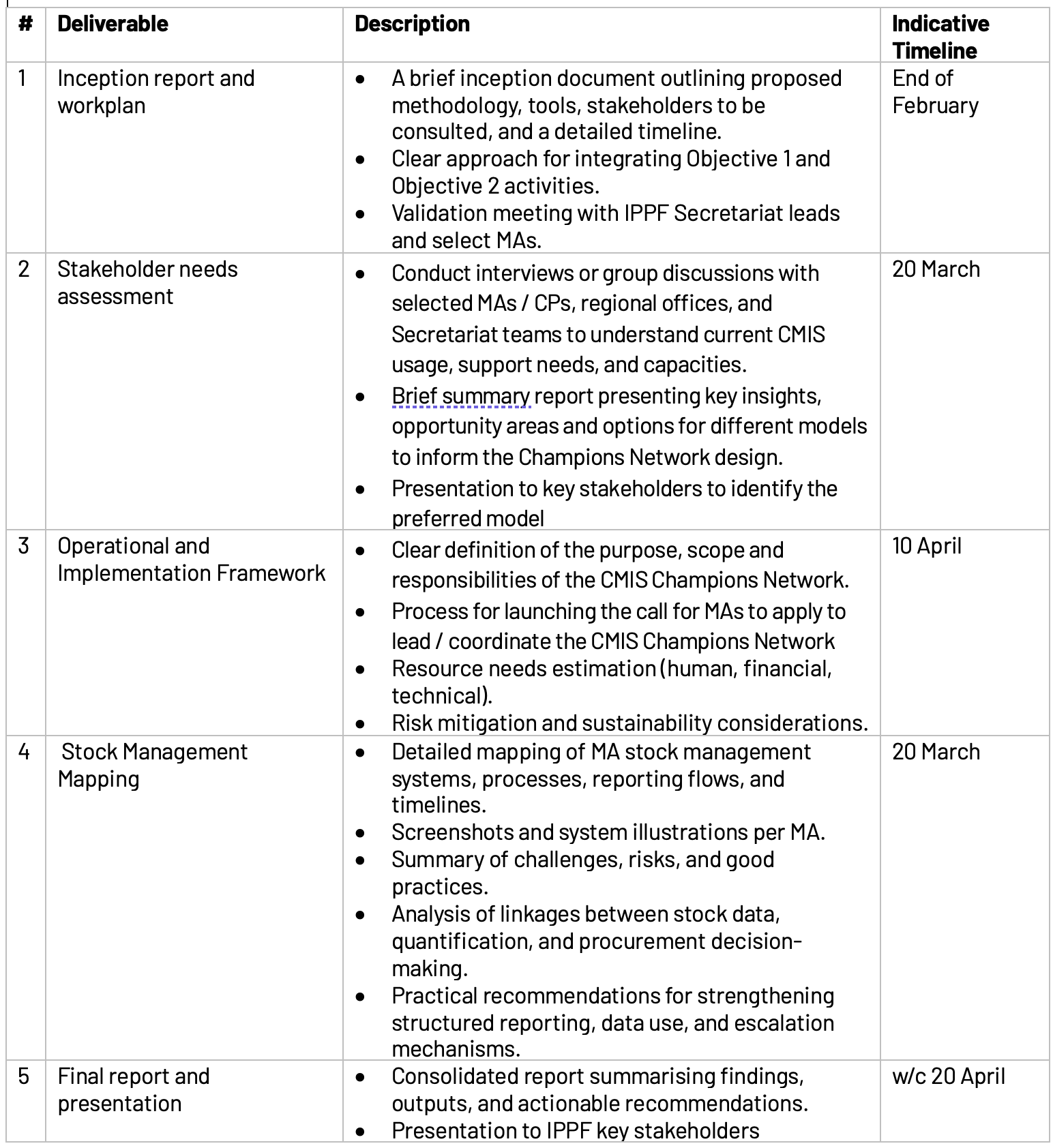
4. Deliverables
5. Required Qualifications and Experience
- Technical Expertise
- Strong experience in health information systems (HIS), digital health, or clinical data systems implementation—ideally including CMIS or similar platforms.
- Demonstrated understanding of data‑driven service delivery, digital transformation in health, or health programme performance management.
- Experience designing or supporting networks, communities of practice, peer‑learning groups, or capacity‑strengthening initiatives.
- Consultancy and Analytical Skills
- Proven ability to conduct needs assessments, stakeholder consultations, and organisational analysis.
- Strong skills in synthesising diverse inputs into clear, actionable frameworks and deliverables.
- Ability to propose practical, scalable, and context‑appropriate solutions within resource‑limited settings.
- Ability to work independently, meet deadlines, and produce high‑quality outputs.
- Sector and Organisational Experience
- Experience working with federated organisations, INGOs, or multi‑country programmes (experience with IPPF or SRHR organisations is an asset).
- Understanding of governance models, capacity development approaches, and cross‑functional coordination mechanisms.
- Communication and Facilitation Skills
- Excellent written and verbal communication skills in English; additional languages (particularly French, Spanish, or Arabic) are an advantage.
- Strong facilitation abilities, particularly in multicultural and multi‑disciplinary settings.
- Availability to engage with geographically dispersed teams across different time zones
The consultant will have a commitment to SRHR, equity and data-driven decision making
7. Reporting & Coordination

8. Budget & Payment Structure
Payment will be made in tranches linked to milestone deliverables – TBC based on agreed workplan
The budget for this consultancy is $15,000
9. Confidentiality & Data Protection
The consultant must comply with IPPF’s Data Protection Policy.
No raw data or dashboards will be stored or shared externally without written consent.
10. Proposal submission requirements:
Interested consultants are invited to submit a proposal that clearly demonstrates their suitability for the assignment and their understanding of the scope of work outlined in these Terms of Reference. Proposals should include the following components:
1. Technical Proposal
The technical proposal should outline the consultant’s proposed approach and methodology for delivering the consultancy objectives and outputs. At a minimum, this should include:
- A brief understanding of the assignment and its objectives.
- A proposed methodology and approach for achieving Objective 1 and Objective 2, including how activities will be integrated where relevant.
- A description of proposed tools, consultation methods, and analytical approaches.
- Any identified risks and proposed mitigation measures.
2. Timeline and Workplan
A clear and realistic timeline outlining key activities, milestones, and deliverables, aligned with the indicative timelines provided in these Terms of Reference.
This may be presented as a table or Gantt-style workplan.
3. Financial Proposal
A detailed financial proposal in USD, inclusive of all professional fees and any anticipated costs associated with the assignment. The financial proposal should:
- Clearly state the total proposed cost.
- Provide a breakdown of costs by deliverable or activity.
- Be aligned with the deliverables and payment structure outlined in these Terms of Reference.
4. Curriculum Vitae (CV)
A minimum CV outlining relevant qualifications and experience of the consultant. The CV should clearly demonstrate expertise relevant to health information systems, CMIS or similar platforms, supply chain expertise, consultancy work, and the scope of this assignment.
5. References
Contact details for at least two (2) professional references from previous or current clients, preferably relating to similar assignments or work within health systems, digital health, supply chain, or international development contexts.
6. Submission
All proposal documents should be submitted electronically in PDF format to [email protected] with a copy to [email protected] with a deadline of 10 February 2026.
Submissions should clearly reference the consultancy title “Design and Establishment of CMIS Champions Network” in the subject line. Late submissions may not be considered.
